Tuesday, 31 March 2020

'Traces of Mithraism in Kent'


The rescheduled Underground Folklore talk did go ahead, but in the present isolation situation all other talks will have to be postponed until later in the year.

In the meantime, I'll endeavour to write up some of the stuff for this blog that's been sitting on my desktop for ages without action.

A while ago we did a circular walk from Appledore in Kent that included a stretch of the Royal Military Canal and a visit to St Mary's church in Stone-in-Oxney. The church was rebuilt following a fire in the fifteenth century and has a number of interesting features, the most unusual of which can be found in the rear of the building under the tower. It is a large almost square piece of carved Kentish ragstone, 2 feet by 1 foot 10 inches and 3 feet 4 inches tall with a distinct carving of a bull on the side facing the viewer - the other three sides are too badly damaged and eroded to make out the images, but it is assumed that they also include carvings of bulls (see Notes and Queries below). It is commonly identified as an altar from a temple dedicated to Mithras that was either on the site of the church, or in the near vicinity.

I've visited a number of Mithraea over the years: San Clemente in Rome, Martigny in Switzerland, and Carrawburgh Roman Fort on Hadrian's Wall amongst others. Of course, one of the most famous is the Mithraeum uncovered along the Walbrook in the City of London after the Second World War that has in recent years been relocated and reconstructed as part of an atmospheric and numinous visitor experience that is highly recommended. See here.

Sculptures from the temple were also preserved and are now on display in the Museum of London. The most interesting shows the culmination of Mithraic rites, the slaughter of a bull, or tauroctony. We saw a very impressive example at the Louvre in Lens a few years ago. See here.

The church at Stone-in-Oxney provides a laminated copy of an article from the journal Bygone Kent (c.2000): 'Traces of Mithraism in Kent' by R.B. Parish (I haven't been able to find the text of this article online for a link, but I quote from it below) which is very informative.

A basin has been carved into the top of the stone and the article quotes Rev. Grevile Mairis Livett (misspelled as Levit) Fellow of the Society of Antiquaries (his obituary can be found here): 'The most significant feature is the focus hollowed out of the top for the reception of libations made to the god, or of the exta (internal organs) of the slaughtered animals to be burnt, while the flesh was consumed at the sacrificial feast.' It is also noted that the basin once had an iron lining.

Livett's description of the stone continues: 'It has certain peculiar features: there is no inscription such as is usually found on Roman altars on the front face, while the sides are usually blank or may have symbolic carving on them, the back being plain. In this case, the bull, repeated on all four sides, must be regarded as the symbol of the god, and I imagine it must indicate the devoting of the altar to the soldier's god Mithras, though his altars are generally sculpted with a representation of the taurobolium ie. Mithras slaying the bull.'

'Set into the foot of the structure is an iron ring which rather erroneously has been suggested was where victims were secured to be sacrificed. This would, however, appear to be unlikely and it would be more feasible that it was set into the stone when it was used as a horse mounting block and thus was to tether the horses to.'

The stone is mentioned in Notes & Queries Oct 23 1869 (p.347): Stone Altar. This object is not noticed in the Archaeologica Cantiana. The only account I have seen of it ... is the following from Murray's admirable Handbook: "In the garden of the vicarage of Stone is preserved an ancient altar (Brito-Roman?) which before its removal there had, time out of mind, been kept in the church. It had figures of oxen on four sides, only one of which is now perfect. At the foot is an iron ring for securing victims (?) and vestiges of the iron lining to the basin existed until very recently. This altar seems to illustrate the name of the district, 'Oxney', the cattle island."'

The village website informs us: 'At that time the temple and its military outpost would have been on the coastline, overlooking an extensive marshy delta. The higher ground of the Isle of Oxen formed the edge of the great Wealden forest of Anderida.'

Tradition had it that the stone had been discovered at an unknown date under the north chapel floor where it remained until the eighteenth century when it was moved to the vicarage garden and used as a mounting block for horses. Historian Edward Hasted noted that during this period 'it suffered considerable damage, becoming cracked and mutilated.' Hasted's History of Kent has an illustration, as does Camden's Britannica, according to Parish's article.

It's worth reading 'Historical Notes on the church of Stone in Oxney, Kent' by W.H. Yeadle (1935) which can be read as a pdf here.

In the early 1920s antiquarians wanted the stone to go to Maidstone Museum or be protected by a shelter, but in 1926 it was moved from the vicarage garden to its present location inside the church, a feat achieved by public subscription and support of the Kent Archaeological Society.

It has been suggested that the altar may have come from the Saxon Shore Fort called Stutfall Castle at Lympne. See here.

Interestingly and I suppose inevitably local folklore also includes tales of secret tunnels in the vicinity, to quote from the Bygone Kent article once more, with the author's highly speculative interpretations:

'It may also be significant that Kenardington, not far away [about 5 km to the north east] on Romney Marsh, is associated with three interesting pieces of folklore which may have relevance here. One is that the church is built upon a mound, beneath which are said to be "tunnels", for which one could read a Mithraeum. These are bizarrely said to be haunted by a coach, perhaps a folk memory of Roman chariots. The third is that somewhere in the land around it is said to be hidden a golden calf, which is of course the sacred symbol of Mithraism. Sadly no Roman remains have been unearthed to support the theory and the mound on which the church sits is generally believed to be Danish. Yet, these possible folk memories are highly suggestive, and the stratum, sandstone, would be easy to tunnel into. Perhaps then this was another Christianised site, or the altar came from Kenardington.'

In my Secret Tunnels of England I mention the widespread folklore of buried golden calves - possibly a memory of pre-Reformation statues of saints and other Catholic treasures, rather than Mithraic origins. I hope to visit Kenardington soon, as it does not appear in my book, but sounds worth including if there is ever a second edition.

Tuesday, 25 February 2020

Underground Folklore Talk Rescheduled


It is with great regret that, following medical advice, I have had to reschedule the talk on Underground Folklore of England due to take place this Thursday 27 February at Kensington Central Library. It will now take place the following Thursday 5 March. See here. I'm sorry for any inconvenience this will cause to those who were booked.

One good thing about this is that 5 March is St Piran's day. St Piran is the patron saint of tin miners and the legend of St Piran and some of the beliefs and superstitions of the Cornish tin miners will be covered in the talk.

Sunday, 16 February 2020

Decadent London News


News about the revised and expanded edition of Decadent London.

It's now stocked by the following bookshops:

Treadwells

Watkins

Gay's The Word

The Brick Lane Bookshop

Tate Britain will be stocking Decadent London in their bookshop. As there is a major Aubrey Beardsley exhibition about to open this is wonderful news and I would hope that sales will be good if the book is prominently displayed.

It's the largest exhibition of Aubrey Beardsley drawings for 50 years and runs from 4 March to 25 May.  As well as his own distinctive works the exhibition includes artworks that were important inspirations for him including those by Edward Burne-Jones and Gustave Moreau.

More about the Beardsley show here.

I'm doing some talks about Decadent London:

Thursday 20 February   Treadwells Bookshop here

Thursday 9 April City of Westminster Archives Centre (details to follow)

Also a non-decadent talk about underground folklore of England

Thursday 27 February Kensington Central Library here (part of Fantasy February)

Thursday, 13 February 2020

Netherwood and Night Tide


Finally managed to get round to buying a copy of Netherwood by Stephen Volk - it's the last part of  The Dark Masters Trilogy of novels. It's a strange experience reading it, as I can see how much background material has been used from Netherwood: Last Resort of Aleister Crowley. The author remains very faithful to much of the detail about the house and characters such as Vernon Symons, while introducing a sinister villain of his own invention. It should also be said that Dennis Wheatley had met Crowley, but never visited him at Netherwood. Very flattering really and I have to thank the person who alerted me to it at my Treadwells talk last year.

In the acknowledgements in the back Stephen Volk thanks me and my co authors for the book, which he bought from a 'dingy' bookshop (I know the one) in Hastings Old Town on a research trip. It's great to know that some of one's work is inspiring or being used by other writers, artists and musicians. I know that a play has been written about Netherwood (not sure if it has ever been performed) and it has been used in the work of Gareth E Rees. Subterranean city has been an inspiration for a number of artists including Stephen Walter (see here), fiction writers and a dancer.

Also this week I watched a newly reissued film called Night Tide (1961) starring a young and handsome Dennis Hopper. See here. Once more a Crowley connection that I hadn't been aware of when I bought it. Director Curtis Harrington was a friend of Kenneth Anger and appeared in his film Inauguration of the Pleasure Dome (1954), together with Marjorie Cameron about whom he later made a film called Wormwood Star (1956). See here. She also appears in Night Tide. Harrington was obviously mixing in the LA occult circles chronicled in The Unknown God; apparently he financed his final short film Usher by selling a signed Crowley book he owned. He was obsessed with the work of Edgar Allen Poe and it's interesting that a version of The Fall of the House of Usher was made at Netherwood by George Ivan Barnett during the time that Crowley was living there (see previous posts).

Cameron (she was often known just by her surname) had been the lover of Jack Parsons  and the sex magic partner for his infamous Moonchild operation, about which Crowley wrote to Karl Germer: 'Apparently Parsons, or [L Ron] Hubbard, or somebody is producing a Moonchild ... I get fairly frantic when I contemplate the idiocy of these goats.' To Parsons Crowley wrote 'I cannot form the slightest idea of what you can possibly mean.'

I haven't seen the American television series about Parsons called Strange Angel (some episodes were directed by Ben Wheatley). As it was cancelled after season 2, maybe it will emerge on DVD.

Incidentally, Crowley still manages to generate shock horror headlines over 70 years after his death - see this Daily Mail article from this week.

Thursday, 6 February 2020

Publishing Projects


One day I'm going to write a long post about the pros and cons of setting yourself up as a publisher and being a modestly successful writer who has to have a 'proper' job to survive.

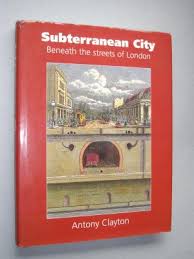
But, for now, briefly, what I wanted to say was that if any (larger) publisher out there is interested in bringing out the third revised edition of Subterranean City then please get in touch or leave a comment.

Last year I tried two mainstream publishers - one commissioning editor was very keen until the bean counters got involved and that was that. The whole process of dealing with just two publishers served to remind me of the benefits of being one's own publisher - it does save a massive amount of waiting around, frustration and disappointment. It's not something I intend to do for months at a time this year, so if anyone is interested they can contact me. I've already been engaged on the updating and revision process since Christmas.

I'm perfectly prepared to publish it through Accumulator Press, but it has to be said that the distribution and publicity (the biggest problems for a small press) available to a large established publisher would hugely benefit sales of a book of this type - as it did in the past, when it was selling thousands of copies each year. The subject is still of great interest and since Subterranean City was first published a small industry of books on underground London has flourished.

The rights to all my early books have reverted to me, so I am free to do what I like with them - I've already published a new edition of Decadent London for example (about which I may soon have some exciting - for me - news). I would also like, when funds allow, to publish the work of other non-fiction writers.

I shall update on any developments ...

Ghostland


Just finished reading Ghostland, In Search of a Haunted Country by Edward Parnell (William Collins, 2019) a psychogeographic journey around the country seeking out the places where various classic ghost stories were set, or places associated with the authors' lives.

All the usual suspects are present and correct: James (M R), Blackwood, Machen, Aickman, E F Benson, Walter De La Mare etc. The book also covers the recently fashionable 'folk horror' genre and the classics - many of them mentioned in posts on this blog - Witchfinder General, The Blood on Satan's Claw, The Wicker Man, The Owl Service and Penda's Fen. While I had read or seen most of them, there are a number of ghostly novels and short stories I wasn't familiar with, some of which I shall now seek out. For example I'm now reading Nine Ghosts by RH Malden who is considered one of the better MR James imitators. See here.

The book's most obvious debt is to W G Sebald's The Rings of Saturn (which supplies the book's main epigraph - the layout of text and pictures is very similar). Obviously, that's a hard act to follow and it's interesting that Parnell tests out some of Sebald's text by revisiting locations and finds much of it more fictionalised than he (and I) had imagined. He also gets down to Cornwall and visits the area around Zennor associated with Crowley and the 'mysterious' death of Katherine Arnold-Foster that I wrote about in recent blog posts. Ghostland is also a meditation on illness, loss, grieving and memory - the journeys were undertaken as a form of nostalgia for the author's boyhood and places visited on family holidays.

I really enjoyed reading it and you might do too. A review from the TLS here.


It's also worth mentioning a recently-uploaded large archive of 'occult' recordings freely available here that also includes recordings of Aleister Crowley and the perennially disturbing Enfield Poltergeist.

Monday, 3 February 2020

Netherwood and Father Divine


Watching the recent harrowing BBC4 documentaries on Jonestown (I remember buying a cassette of the 'Jonestown  Death Tape' from a street vendor in New York many years ago), reminded me of my interest in younger days in religious cults and charismatic cult leaders (Anthony Storr's Feet of Clay is an excellent introduction) - of course Crowley also fits perfectly into this category.

It also brought to mind an episode in the history of Netherwood before the arrival of the Great Beast, that I discovered by laborious wading through microfilm editions of The Hastings & St Leonards Observer (it wasn't digitised until after the first edition of Netherwood was published).

Netherwood under the ownership of Vernon and 'Johnnie' Symonds played host to a series of radical, stimulating and varied events that drew famous speakers and enthusiastic audiences to the Hastings guest house. In January 1939 The Daily Mirror proclaimed that Netherwood was to host: 'Europe's first "Extension Heaven" according to the style of America's Father Divine, the negro who calls himself "God"'.

Father Divine (c1876-1965), probably born George Baker - his early life is shrouded in mystery, he later called himself Reverend Major Jealous Divine - was a charismatic African American spiritual leader who from around 1912 claimed he was God. He built up a significant following amongst African Americans (around 25% of his followers were white) and from 1932 to 1942 was based in Harlem, New York.

Disciples purchased several hotels there, which became known as 'Heavens', where followers could live cheaply and practice his teachings; other local businesses were also bought up - further 'Extension Heavens' were soon established elsewhere. Dogged by controversy and scandal (much of it no doubt racist-inspired), Father Divine relocated to Pennsylvania, where his following and health gradually declined, although he continued to preach in favour of certain civil rights and against bigotry. He died in 1965 and was succeeded by Mother Divine (his Canadian wife Edna Rose Ritchings (c1925-2017). An obituary of Mother Divine here.

Feastings and lavish banquets were part of Father Divine's form of worship and celebration and it was this aspect of a 'Heaven' that was to be emulated at the Netherwood gathering, together with 'all night dancing and singing'. There's a very useful article about the Father Divine and the feasts here.

The 'rally of Father Divine's English disciples' centred around a Mrs Joyce Newton from Fulham who, having spent two weeks in Harlem, returned converted to the doctrine of Father Divine - her husband and three sons were also followers.

In the article Vernon Symonds is quoted as telling the Mirror reporter: 'that there must be something in the doctrine that has attracted so many people black and white' and had therefore, 'agreed to make his home the starting point of a national campaign'. He added 'I have no financial interests in the venture, but believe that these well-meaning people should be given a chance to make their faith known in England.' On the evening of 4 February 1939 around 40 people were to arrive at Netherwood, where 'disciples of Father Divine will mingle with those who want to learn something of the new religion.'

A few days before the event was due to take place the Hastings & St Leonards Observer carried an article with the headline 'Father Divine Party -"Misleading" Newspaper Publicity' in which Vernon Symons commented: 'The statements alleged to have been made by me to newspaper correspondents over the weekend are completely fictitious and should be disregarded.' He explained: 'I do not know anything about the teaching of Father Divine. From what I have been able to gather from the popular press, I imagine I shall have little sympathy for his message, but I am anxious to know all I can about any movement that achieves wide publicity.'

Despite the fact that Vernon's political and religious views would probably have made him sympathetic to Father Divine's cause, the event was cancelled, owing to the 'very unpleasant publicity' (his words) it had received in advance; Vernon Symonds had no plans to rearrange it.

Monday, 13 January 2020

Arthur Calder Marshall and Aleister Crowley


With reference to the earlier post in which Julian Maclaren-Ross recounted meeting Arthur Calder Marshall at a party in the 1940s I discovered that Calder Marshall had written an autobiography The Magic of My Youth in which Crowley features heavily. It's a very readable, amusing and interesting account that should be read by anyone interested in Crowley and his associates; there are other moving accounts of strange characters at Oxford and Calder Marshall comes across as a decent chap.

As a youth in the West Sussex village of Steyning he befriended an eccentric local poet and publisher who he calls Vickybird who dominates much of the book - he was in fact an earlier friend and sexual partner of Crowley, Victor Neuburg (see Jean Overton Fuller The Magical Dilemma of Victor Neuburg, 1965 - I see that my old university has a Neuburg Collection).

Calder Marshall grows up familiar with the notoriety of Crowley, a fairly constant presence in the press of the period and eventually gets to meet him in 1929. This, of course, contradicts Maclaren-Ross's memories, where he writes that CM had not yet met AC in the 1940s. Two encounters with the Great Beast take place, one in the famous Eiffel Tower restaurant in Percy Street and another during a period when AC was living in the village of Knockholt (1929-30) in a cottage with his then wife Maria de Miramar.

Calder Marshall paints a suitably sinister picture of Crowley who appears to be trying to ply him with brandy and hypnotise him into possibly working for him and staying the night, when Lord knows what devilry might take place - but he manages to steel himself to leave.

'I looked across at the old man bent over the table with the brandy bottle at his elbow. He was scowling as much at me as at Eleanor [CM's girlfriend]. "What would you say we have been doing, sir?" I asked.
"I'd say I'd been wasting my time," he said, and he picked up the brandy bottle and carried it to the cupboard. "But at least, sir," I said, "I must thank you for saving a great deal of mine." 'p.193

Calder Marshall had also asked Crowley to deliver a lecture at Oxford which he agreed to do, choosing medieval child murderer Gilles de Rain as his subject. The lecture never took place as the university authorities banned it - Crowley later had it printed as The Banned Lecture (1930).

The book is also worth reading as yet another account of Fitzrovia and its pubs and characters, where he encounters other Crowley associates such as Betty May and Nina Hamnett.

Extracts from book were read by Alan Rickman on BBC radio in 1985 and thanks to the miracle of YouTube you can hear all of them - quality is not great but audible. Here's a link to episode 5 where he finally meets Crowley (whose surname Rickman pronounces correctly).


Wednesday, 18 December 2019

2020 Talks


Three talks have been confirmed this year, with more in the pipeline.

NEW ADDITION: DECADENT LONDON at TREADWELLS BOOKSHOP
Thursday 20 February 7.30 pm: see their website for details. HERE

Thursday 27 February SECRET TUNNELS: FOLKLORE OF UNDERGROUND ENGLAND
Kensington Central Library Lecture Theatre  6.30-7.30 pm FREE. More information and book through Eventbrite here
Part of a mini Folklore Festival in which, amongst others, Christopher Josiffe should also be giving a talk.

Thursday 26 March WHISTLER: CHELSEA'S GREATEST ARTIST Chelsea Library 6.15-7.15 pm
More information and book through Eventbrite here FREE

Thursday 9 April DECADENT WESTMINSTER City of Westminster Archives Centre 10 St Anne's St, Westminster, SW1P 2DE (details to follow)  FREE

Sunday, 8 December 2019

New Edition of Decadent London


The new revised and expanded edition of Decadent London has arrived from the printers and it looks and feels great. It is now over 400 pages in extent and includes a walk around 1890s London at the back.

Available for purchase now from The Big Cartel here

Treadwells bookshop, Bloomsbury, London here

Watkins in Cecil Court, London here

Gay's The Word, London here

More outlets to follow.

Review of the first edition from The Independent on Sunday here

Review of the first edition from The Open University here

Thursday 12 December 'Oscar and Friends' A free talk at Kensington Central Library with Nina Antonia and Darcy Sullivan here  Copies of Decadent London will be on sale at this talk for a substantial discount.

Very limited numbers of Secret Tunnels of England: Folklore & Fact available from Big Cartel here


DECADENT LONDON BY ANTONY CLAYTON, FOREWORD BY MAX DECHARNE

As the dawn of the twentieth century loomed, London was undergoing tremendous changes, establishing itself as the heart of one of the most powerful empires the world has ever seen. However, in the same decade that witnessed the celebrations of Queen Victoria's Diamond Jubilee a diverse group of writers, artists and poets sought to subvert the oppressive cultural and moral atmosphere of the period. This was the city explored by Oscar Wilde, Arthur Symons, Aubrey Beardsley, Frank Harris and Ernest Dowson, together with their less well-known compatriots Lionel Johnson, John Gray, John Davidson and the mysterious Count Stenbock.

Using a thematic approach, Decadent London recreates the artistic milieu of this turbulent time, described the most popular decadent destinations and provides concise biographical material on the central characters, many of whom became victims of their excessively louche lifestyles. Visit the raucous decadent pubs such as The Crown and The Cock, listen in at the Cheshire Cheese, where W B Yeats read his poems to the Rhymers' Club, enjoy the wit of Wilde and Whistler at the Cafe Royal and explore the idyllic artistic retreat of Bedford Parkin the suburbs. The book also describes the work produced by London's decadent writers and artists, particularly their contribution to the decade's most innovative periodicals The Yellow Book and The Savoy. It outlines the development of the burgeoning music hall scene beloved of many decadents, probes into the underworld of drug taking, pornography and prostitution and uncovers the occult pursuits of the Golden Dawn and the Great Beast Aleister Crowley.

THIS INFORMATIVE GLIMPSE INTO ONE OF THE MOST FASCINATING PERIODS IN THE CAPITAL'S CULTURAL HISTORY HAS BEEN FULLY REVISED AND SUPPLEMENTED BY NEW MATERIAL.